
Subfloor Moisture Levels: The September Shift and Your Floors
By Autumn Sibo,
Subfloor moisture levels are something I discuss with customers here at our Highland, Indiana, showroom almost every week. Most people do not realize that the biggest threat to a new floor is not a spill, a pet, or even heavy foot traffic. It is the air in their own home that subtly changes between August and October. That transition is what we call the September Shift, and understanding it could save your floor.
What Is the September Shift?
The September Shift is the dramatic change in indoor humidity that happens in Northwest Indiana and the Chicagoland area every year between late August and mid-October. In late August, outdoor humidity is high. That humid air works its way into your home and into your subfloor. Then, almost overnight, the temperatures drop. You turn on the furnace for the first time. And that warm, forced-air heat pulls moisture out of everything, including your floors. That is the shift at work.
Your subfloor moisture levels can swing dramatically in just a few weeks. That swing is the number one cause of floor failure we see. Not a bad product. Not a faulty install. Just humidity doing what humidity does in the Midwest. That is why moisture control matters before installation.
Why Do Subfloor Moisture Levels Cause Gapping and Cupping?
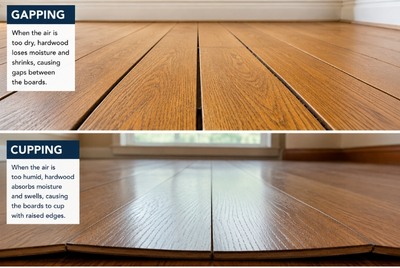
Subfloor moisture levels directly affect how wood-based flooring behaves, and the answer is simple. Wood moves. It always has. That movement is what leads to the problems below.
When subfloor moisture levels are high, wood absorbs that moisture and expands. When levels drop quickly, the wood releases moisture and contracts. If those changes happen too fast, or if the floor is not given time to adjust before installation, you end up with two of the most common floor failures we repair:
- Gapping: Boards shrink and pull apart from each other, leaving visible gaps between planks. This is extremely common in hardwood and laminate installed without proper acclimation.
- Cupping: The edges of boards rise higher than the center, creating a concave shape across each plank. This usually happens when moisture levels are uneven between the top and bottom of the board.
I see these two problems more than I would like to. The good news is that most of the time, they were completely avoidable. The September Shift catches people off guard because nobody warned them it was coming.
What Is Equilibrium Moisture Content, and Why Does It Matter?
Equilibrium Moisture Content, or EMC, is honestly one of those terms that sounds way more complicated than it is. All it means is that the wood has stopped fighting with the air around it. It has absorbed or released enough moisture to match whatever the environment is holding. Your floor is not gaining moisture. It is not losing it. It has settled in.
I usually describe it to customers this way. Picture a wooden board as a living, breathing thing, because in a lot of ways it still is. Put it in a humid room, and it drinks. Put it in a dry room, and it gives back that moisture. EMC is just the moment when it has nothing left to give or take.
Every home has its own EMC based on:
- The average indoor temperature
- How often and how long the furnace or air conditioning runs
- The home’s age and insulation quality
- Basement or crawl space conditions
- How many people live in the home
Here in Highland and across the Chicagoland area, EMC values shift significantly between summer and winter. A home might sit at 12 to 14 percent moisture content in August and drop to 6 to 8 percent by January when the furnace has been running for months. That is a massive swing. And if your floor was installed before it reached the right EMC for your specific home, it will try to reach that balance after the fact. That is when gapping and cupping happen. That is the connection to keep in mind.
How Is Expert Acclimation Different from a DIY Approach?
 This is where I really want to give you an insider tip, because this is something big-box store sales associates almost never explain. Before you compare approaches, it helps to know what each one actually does.
When you buy flooring at a large home improvement store and handle the installation yourself, the standard advice is to let the flooring sit in the room for 48 to 72 hours before you install it. That sounds reasonable, right? But here is what that advice leaves out. It does not account for how the room will change later.
Forty-eight hours in a room that is currently 78 degrees and humid from late summer does not tell you anything about what that floor will do when your furnace kicks on in October. The floor acclimated to the conditions it was sitting in, not the conditions it will actually live in long term.
Professional acclimation is a completely different process. Here is what it actually involves: it starts with the subfloor and moves from there.
- Moisture test the subfloor first. We use meters to measure what the subfloor is actually holding before anything else happens. If subfloor moisture levels are too high, we wait or address the source of the moisture.
- Testing the flooring product itself. We measure the moisture content of the flooring and compare it to the subfloor reading. The gap between those two numbers tells us whether the product is ready.
- Accounting for your home’s seasonal patterns. A home in Highland that runs the furnace heavily all winter will have very different long-term EMC conditions than a home that stays cooler. We factor that in.
- Recommending the right product for your home’s actual conditions. Sometimes the right answer is that solid hardwood is not the best fit for a particular room. Engineered hardwood handles moisture fluctuations much better because of its construction. And for basements or rooms with higher humidity, luxury vinyl is often the smartest choice because it does not absorb moisture.
Why That Gap Matters
Here is the honest truth. A big-box store is set up to move product, not to solve your specific problem. Nobody there is going to come to your house in Highland, pull out a moisture meter, and tell you that maybe this is not the right time to install that floor. We do that. It is just a completely different experience, and your floors end up better for it.
That difference is exactly what we write about in our blog on why local flooring stores beat big-box retailers. If you have not read that one, it is worth a few minutes of your time.
Which Floors Handle the September Shift Best?

Karndean Van Gogh Gluedown in Hessian Oak (VGW93T)
Not all flooring is equally vulnerable to subfloor moisture level swings. Here is a quick breakdown, so you can compare the options more easily:
- Solid hardwood: Most sensitive to moisture changes. Beautiful and long-lasting when installed correctly, but requires the most careful acclimation and ongoing humidity management. See our full hardwood flooring page for more.
- Engineered hardwood: This one is my go-to recommendation when someone loves the look of wood but has a home that runs warm in summer and dry in winter. Because it is built in layers with the grain running in different directions, it does not expand and contract as dramatically as solid hardwood does. It still needs to acclimate properly before installation, but it is a much more forgiving product when the seasons change.
- Laminate: Sensitive to moisture at the edges and seams. Not ideal for rooms with changing subfloor moisture levels. Best kept in dry, stable spaces.
- Luxury vinyl plank (LVP): Waterproof and dimensionally stable. LVP does not absorb moisture, which means subfloor moisture levels affect it far less. It is our best recommendation for rooms where humidity is a concern.
- Carpet: Naturally cushioned and somewhat forgiving of minor subfloor moisture variations, though a wet subfloor will cause mold and odor issues over time. Always address the source first.
What the Real-World Results Tell Us
For a deeper look at how these products hold up over time, I put together a full breakdown in our guide to the most durable flooring. It covers real-world results from 35 years of customer feedback right here in Northwest Indiana and the Chicagoland area.
How Can I Manage Subfloor Moisture Levels at Home?
The good news is that you are not powerless here. There are real, practical things you can do to keep your subfloor moisture levels stable year-round, and the next few steps are a good place to start:
- Run a humidifier in winter. When the furnace is running hard, indoor air gets very dry. A whole-home humidifier helps keep levels steady and protects wood-based floors.
- Use a dehumidifier in summer. Especially in basements and main-level rooms with below-grade walls. Removing excess moisture from the air reduces what the subfloor absorbs.
- Keep the thermostat consistent. Wild temperature swings between day and night drive changes in humidity. A consistent temperature helps stabilize your floor.
- Seal your basement or crawl space. Much of the subfloor moisture in Highland and Mokena homes comes from below. Vapor barriers and proper sealing make a considerable difference.
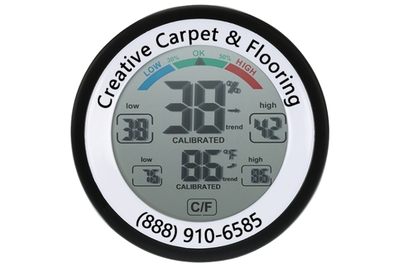
- Get a digital hygrometer. These are inexpensive and easy to find. Knowing the relative humidity in your home gives you real information to act on. The target range for most wood floors is 35 to 55 percent relative humidity. That is the number to watch as conditions change.
Quick Answers: Subfloor Moisture Levels FAQ
What are acceptable subfloor moisture levels before installation?
Most hardwood installers look for subfloor moisture content between 6 and 9 percent in a typical Midwest home. The flooring product itself should be within 2 to 4 percentage points of the subfloor reading.
Can I fix a floor that has already cupped or gapped?
It depends on what caused it. Gapping from a dry winter often closes back up once summer humidity returns. Cupping can settle down on its own, too, once moisture levels even out. The trick is finding the source first. Fix the floor without fixing the cause, and you will be back in the same spot next fall. Severe cases may need hardwood refinishing or replacement, but that is always the last resort.
Does luxury vinyl have subfloor moisture concerns?
People assume waterproof means nothing below matters, and that is where it gets tricky. LVP will not absorb moisture through its surface, but too much subfloor moisture can cause a glue-down installation to lose its grip or create instability in a floating floor that you will eventually feel underfoot. We still test moisture levels before any LVP goes down. The floor might not care about water, but the subfloor does.
Is the September Shift worse in some homes than others?
Yes. Homes with basements, older construction, less insulation, or significant air leaks tend to see more dramatic humidity swings. A consultation with our team helps identify how much of a concern it is for your specific home.
Come Talk to Us Before the Shift Happens

The best time to think about subfloor moisture levels is before you buy a floor. Not after it starts gapping.
If you are planning a flooring project this fall, come see us before you make any decisions. We will talk through your home’s specific conditions, walk you through the right products for your situation, and make sure your installation is done when the timing is right.
Stop by our Highland, Indiana, showroom at 2315 45th Street anytime. Coming from the Illinois side? Our Mokena, Illinois, showroom at 19845 S. La Grange Road is ready for you, too. Both locations share a devotion to honest advice and to floors installed right the first time.
Scheduling a showroom consultation online is also an option. We would love to see you.